Grok Bot vs Claude Cowork: which AI teammate actually fits a real estate operator
xAI shipped Grok Bot this week and Anthropic's Cowork has been running since January. They solve the same problem in very different ways. Here is the honest comparison, including where each one falls down.
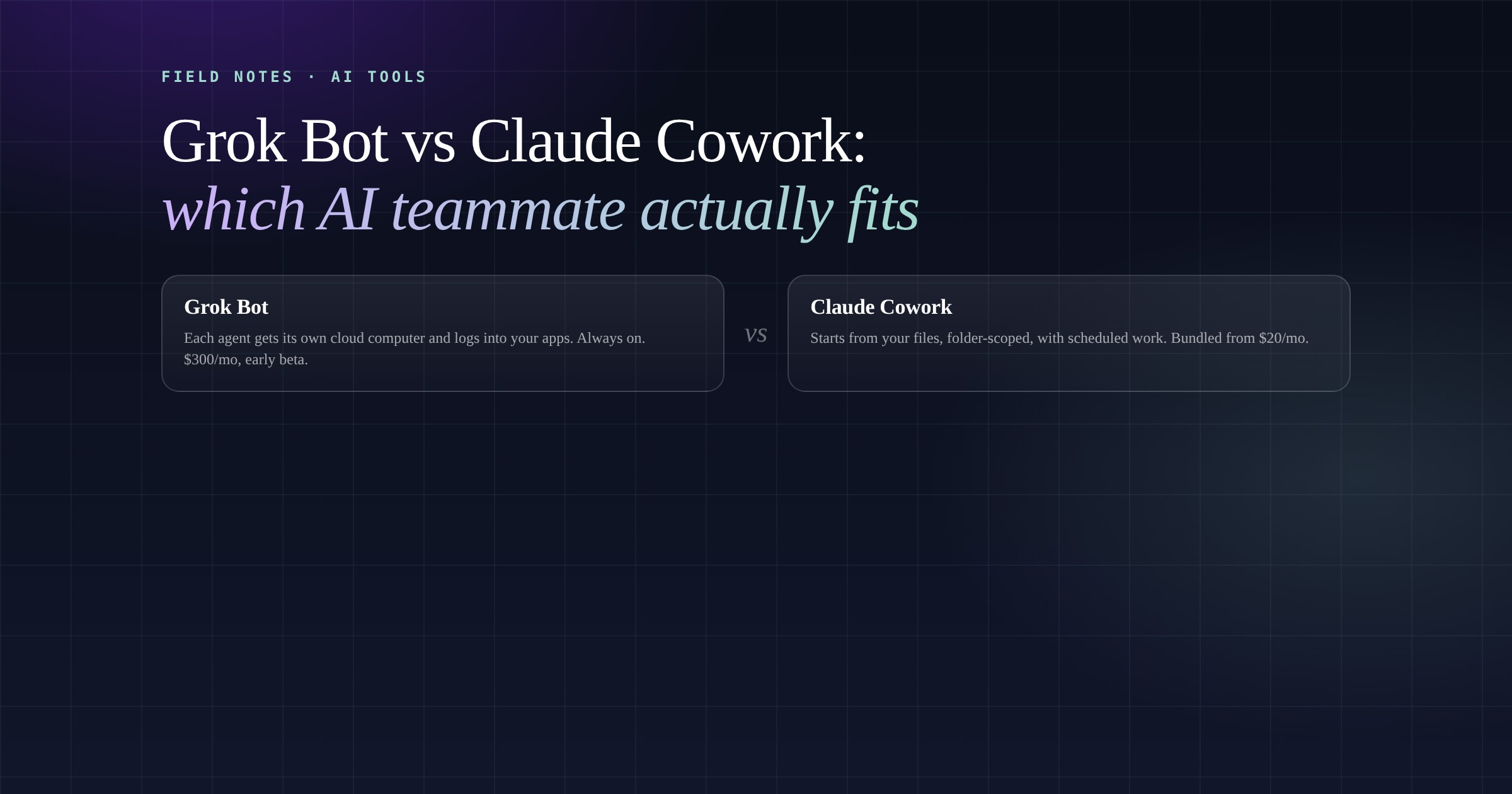
xAI announced Grok Bot on August 11. It is the first product from a major lab that is explicitly not a chatbot and not a coding tool: it is an agent that logs into your software and does the work. Anthropic has been shipping the same idea as Claude Cowork since January, and expanded it to web and mobile in July.
Two serious companies now sell you an AI teammate. They made opposite architectural choices. Below is what each one actually is, where each is genuinely better, and which fits the way a brokerage or a property management firm really operates.
Disclosure worth making up front: we run Cowork daily, and this article was drafted inside it. We have not run Grok Bot in production, because it launched three days ago and sits behind a $300 a month plan. Everything below about Grok Bot comes from xAI’s launch materials and early reporting, and we have flagged where that is the case.
The architectural split
Grok Bot gives each agent its own computer. Per xAI’s launch coverage, every bot runs on its own cloud machine, opens your applications, and works across apps and inboxes the way a remote contractor would. It runs whether or not your laptop is open. Credentials are handled by what reviewers call a sign in and hand back pattern: the bot navigates to the login screen, you authenticate, it carries on from its own browser. You can also teach it a task by screen recording rather than describing it.
Cowork starts from your files. It reads the folders you point it at, with permission scoped folder by folder, and it can run scheduled and background work. The July update put the same sessions on web and mobile, so a task you start on a laptop keeps running after you close it.
The distinction that matters: Grok Bot is built around driving your applications. Cowork is built around holding your material. Most real estate work is a mix, and which half dominates should decide your answer.
Where each one is genuinely better
Grok Bot wins on always-on and on apps without APIs. If the work lives in a system with no integration, a legacy property management portal, a county permit site, a lender extranet, an agent that can log in and click is the only thing that works. Its mobile parity is real, including taking over a live session from a phone. And teaching by screen recording is a smart answer to the hardest part of automation, which is describing a process precisely enough for a machine.
Cowork wins on cost, on documents, and on judgment work. It is bundled into Pro at $20 a month and Team at $25 a seat with no separate SKU, against Grok Bot’s $300 a month SuperGrok Heavy or $120 a seat team plan and no free tier. That is not a rounding difference for a small firm; it is the difference between trying it and not. Anthropic’s own usage data across 1.2 million sessions puts business process operations at 33.4%, reports, reconciliation, checklists, which is close to the shape of a property management back office.
Where each one falls down
Neither is finished, and you should know the gaps before you buy.
Grok Bot is in early beta. Reviewers flag that you cannot choose or constrain which model handles a task, which is a problem if you have compliance or cost requirements. There is no voice mode. And the price is the real gatekeeper: at $300 a month you cannot cheaply find out whether it fits.
Cowork has connector gaps that hit our industry directly. Salesforce, Shopify, Square, NetSuite and Zoho are not natively supported as of this year, which means custom work if your CRM is one of them. EU data residency is Enterprise-only. And the honest one: even the strongest current model still invents a statistic or misattributes a quote roughly one percent of the time, so anything going to a lender, an owner, or a court needs a human read before it leaves.
That last point is not a footnote. It is the whole operating principle. We have watched a model produce a clean, internally consistent, confidently wrong analysis, and the only thing that caught it was a human checking the output against a real bank statement. Any vendor telling you their agent removes the review step is selling you a liability.
What we would actually do
If your bottleneck is documents and recurring reporting, owner statements, rent rolls, lease abstraction, weekly reconciliation, start with Cowork. The material already lives in files, the price lets you test it this week, and that is the category where the usage data says it is strongest.
If your bottleneck is a system with no API, and you have been quoted five figures for an integration, Grok Bot’s own-computer model is the more interesting bet. Watch it through beta rather than betting a workflow on it today.
If you are a small brokerage deciding where to spend a first automation dollar, neither answer is the tool. It is picking one workflow that costs you real hours every week, measuring it before you change anything, and being willing to conclude the automation did not help. We built our own back office this way, and the measurable wins came from three or four narrow workflows, not from a general-purpose assistant being clever.
The agent teammate category is roughly seven months old. Both products will look different by winter. The durable skill is not knowing which one to buy, it is knowing which of your processes is worth automating and how you would prove it worked.
If you want help figuring out which of your workflows is the one worth starting with, that is a 30 minute conversation.
Sources: BusinessToday on the Grok Bot launch, AYAutomate’s Grok Bot review, TechCrunch on Cowork’s expansion, Techsy’s Cowork guide. Pricing and features as reported at publication and moving quickly.