
Fable 5.1 did not cut the sticker price. It cut the number that actually drives your agent bill.
Anthropic shipped Fable 5.1 on September 1 at the same $10 and $50 per million tokens. The change that matters to a real estate operator is buried one line down: cached reads fell 75 percent, and re-reading the same rent roll is most of what an agent does.
Anthropic released Claude Fable 5.1 on September 1, alongside Mythos 5.1, its same-weights sibling with looser safeguards for verified cybersecurity and life sciences teams. (Anthropic)
Input is still $10 per million tokens. Output is still $50 per million. If you read the headline and moved on, you would reasonably conclude nothing changed on cost.
Something did. It is one line further down the price sheet, and for the kind of work real estate operators actually put these models on, it is the only line that has ever mattered.
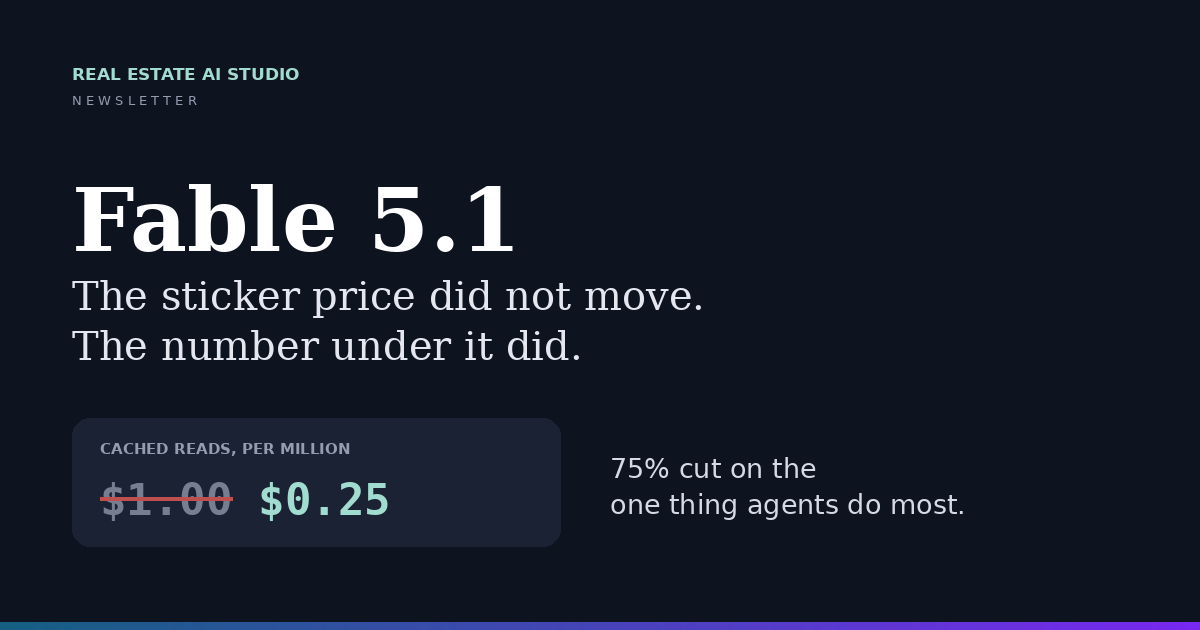
Cached reads went from $1.00 to $0.25 per million
That is a 75 percent cut. It also puts cached input at 2.5 percent of the normal input price, where the going rate across competing models is closer to 10 percent. (VentureBeat)
Prompt caching is the boring plumbing nobody writes about. When you hand a model a large block of context and then ask it question after question against that same block, the provider can keep the processed version warm and charge you a fraction to read it again instead of full freight every time.
Now look at what our work actually looks like:
- A 40 page lease, abstracted clause by clause
- A rent roll and twelve months of operating statements, interrogated from nine angles
- An offering memorandum you want checked against your buy box, then against your lender’s box, then against the last three comparable trades
- A parcel dataset an agent walks across while it decides which sites are worth your Tuesday
Every one of those is the same context, read over and over. Under the old price you designed around that. You trimmed context, you batched questions, you told the agent to be economical about what it looked at twice. Under the new price, re-reading is close to free, and the design constraint mostly goes away.
The operator math
Illustrative, and deliberately small, because the point is the ratio and not the dollars.
Say one asset’s rent roll plus trailing statements comes to roughly 80,000 tokens of context. Say you run an agent over it that re-reads that context 25 times during a single pass, which is ordinary for anything doing real analysis rather than a single summary. That is 2 million cached input tokens.
- Fable 5: 2M at $1.00 per million is $2.00 per asset, per run
- Fable 5.1: 2M at $0.25 per million is $0.50 per asset, per run
Across a 60 asset portfolio, run monthly, that is $120 a month against $30. Nobody is refinancing on the strength of ninety dollars.
The ninety dollars is not the story. The story is that the thing which just got four times cheaper is thoroughness. The version of the agent that reads the whole lease five more times, checks its own work, and goes back to the operating statements before it commits to an answer used to be the expensive version. Now it is barely more expensive than the lazy one.
Anthropic puts the blended effect at roughly 25 percent lower cost on typical workloads and roughly 45 percent on agentic ones. The agentic number is the honest one for anything worth building.
What got better, with the usual asterisk
The capability jumps are concentrated in long-running, multi-step work rather than in chat:
| Benchmark | Fable 5 | Fable 5.1 |
|---|---|---|
| Terminal-Bench 4.0 (agentic coding) | 42.0% | 55.8% |
| Terminal-Bench-Science (agentic research) | 24.7% | 52.6% |
| AutomationBench | 17.1% | 31.4% |
| Humanity’s Last Exam | 57.8% | 60.9% |
The asterisk matters and Anthropic flags it themselves: these are vendor-reported, production safeguards move the numbers, and a few are not cleanly comparable to previously published figures. Treat them as direction, not as proof.
Direction is still worth something. Terminal-Bench-Science more than doubling is the shape of a model that has gotten meaningfully better at not losing the plot forty steps into a job. That is exactly where agents fall over in practice, and it is the reason most people who tried an agent in 2025 concluded agents do not work.
One more change worth knowing if anyone at your firm runs Claude Code: the cyber safeguards now fire roughly 60 percent less often per session than Fable 5’s did, while still refusing to write working exploits. If your developers gave up on it because it kept blocking ordinary security work, it is worth another look.
What we would actually change
Three things, in order of how quickly they pay:
Stop trimming context to save money. If you or your vendor built prompts that hold back the full document to keep the bill down, that tradeoff is mostly dead. Send the whole lease. Send all twelve months.
Check that caching is actually turned on. This entire post is worthless to you if your implementation is not using prompt caching, and plenty are not. It is a specific thing your build has to do on purpose. Ask whoever built yours, and ask to see a bill.
Re-run the jobs you abandoned. If something got shelved in the last year because the model wandered off partway through, the failure mode that killed it is the exact one that moved most. Not everything will pass this time. Some will.
What this is for
Cheap re-reading is not interesting on its own. It is interesting because of what it lets you point at a large pile of records without flinching at the meter.
We built survey.realestateaistudio.com on that idea. It sits on parcel, ownership, zoning, demographic and development-pipeline data for a market, and it turns that into market surveys a client will actually open, at $29 a month. The reason it can go as deep as it does per site is that the model reading all of that context repeatedly is no longer the line item that decides the price. It runs on Cloudflare, it is ours, and it is a fair picture of what this class of tooling looks like when it is built for operators rather than demoed at a conference.
That is the through line. The frontier models are not getting cheaper at the sticker. They are getting cheaper at the specific thing that makes an agent good instead of fast, which is being allowed to look again.
If you want to talk about where that applies in your shop, get in touch.