
Meta Muse, the Muse Charm, and why they work like Grok Bot
Meta launched its Muse agent on September 8 and showed a pocket device for it at Connect. Under the hood it is built almost exactly like xAI's Grok Bot, and that shared design is what a brokerage or property management firm should plan around.
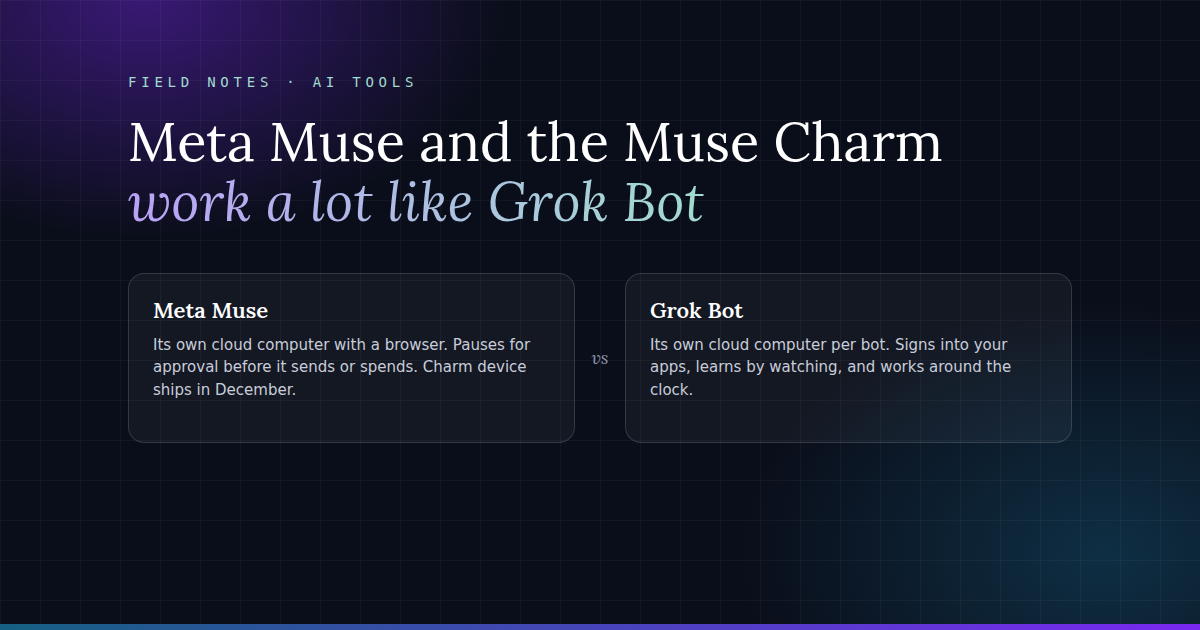
Meta launched Muse on September 8, a personal AI agent that carries out tasks on your behalf, and two weeks later at Connect it showed the Muse Charm, a palm-sized device built to carry that agent around with you. (Meta, Axios) Muse is free for most use, with a Power plan at $20 a month and a Maximum plan at $100 a month. (TechCrunch)
If you read our August piece on Grok Bot and Claude Cowork, the design will look familiar. xAI and Meta arrived at nearly the same architecture from different directions, and that shared design is the most useful thing in either announcement for anyone running a brokerage, a property management office or an investment team.
A disclosure up front: we have not used Muse or the Charm. Everything about them below comes from Meta’s announcement and launch reporting, linked where it appears.
What Muse is
Muse runs on what Meta calls the Muse Secure VM, a dedicated computer in Meta’s cloud with its own browser. From there it sends email, books travel, fills out forms and shops. It keeps working after you close the app and comes back to you when it needs approval, for example before it sends an email or makes a purchase. (Meta)
The security design is the part worth studying. A separate Sentinel agent runs on the same machine, kept apart from Muse at the system level, and approves Muse’s access to the internet. Muse cannot see your passwords or payment methods, you connect apps one at a time and choose how much access each one gets, and you get an audit trail of what it has done and what it plans to do. (TechCrunch)
At Connect on September 23, Meta added a real-time avatar you can video chat with, Muse on the Mac with the ability to operate any desktop app, its own email address so you can forward mail to it, glasses support in the coming months, and shopping partners including Best Buy, Walmart and Wayfair. Zuckerberg said Meta will keep Muse free for a large amount of use and expects to make money from a small fee on transactions. (TechCrunch)
The Muse Charm
The Charm is a palm-sized device with a roughly 2-inch OLED touchscreen showing a Muse character you can customize. It has front and rear cameras, which Meta describes as a way to give Muse visual context for what you are asking about, plus speakers, microphones, 5G and USB-C. You set it up through the Muse app on iPhone or Android. It ships in December, Meta has not announced a price, and Bloomberg reports it should cost about as much as a smartwatch. (9to5Mac, Bloomberg)
How it lines up with Grok Bot
xAI launched Grok Bot on August 11 as a team of always-on agents. Each one works on its own computer in the cloud, signs into your apps and websites including ones with no clean API, learns a task by watching you do it, and comes back only when something needs your approval. (xAI)
Put the two side by side and the same four pieces show up in both:
- The agent has its own computer in the cloud, so the work runs on a machine that belongs to the agent.
- It works inside your apps the way a person does, logging in and clicking through, which reaches systems that have no integration at all.
- It keeps going after you close the app, and picks the job back up from wherever it left off.
- It stops and asks before anything consequential, like sending a message or spending money.
The differences are about who each one is for. Grok Bot is sold to people who want several work bots sharing context, and it comes with xAI’s SuperGrok plans and Cursor’s paid plans. Muse is one personal agent aimed at everyone, free at the base, with Meta’s business model in commerce and hardware on the way so the agent is always within reach. Grok Bot learns a process by watching you run it once. Muse learns what matters to you over time, and Meta’s own example is turning a recipe reel you saved on Instagram into a grocery list.
What this means for a real estate operator
When two of the largest AI companies ship the same design a few weeks apart, the design is the part to plan around, because the products on top of it will keep changing.
Systems with no API come into range. County permit portals, lender extranets and older property management software have always been the expensive part of any automation. An agent that logs in and clicks can pull a report or check a status from those sites, which opens up work that has always needed a custom integration quote.
The approval gate is the control that matters. Both products pause before sends and purchases, and Muse adds an audit trail. We run our own shop the same way, with every client-facing email going to a draft for a person to read before it leaves. When you evaluate any agent, ask exactly what it will do without asking you and whether you can see a log of everything it did.
Keep firm and client data in business tools. Muse is a consumer product from a company with a long privacy record, including FTC settlements in 2011 and 2019 and Cambridge Analytica, and TechCrunch’s launch coverage leads with the trust question. (TechCrunch) Use it personally if you like it, and keep rent rolls, owner statements and deal files in tools with business terms and admin controls.
The Charm points at field work. A broker walking a property with a device that can see what they see and take a spoken instruction is a real workflow, like photographing a sign, dictating a note and having it land in the CRM. Whether this particular device is the one that does it for commercial real estate is an open question until it ships in December.
What we would do this month
Pick one task that lives in a portal with no API and costs someone on your team a few hours every week, and write down the steps exactly as they do them today. That write-up is the input every one of these agents needs, it tells you whether the task is worth automating, and it carries over whichever product you end up using.
If you want help picking the task and measuring it, that is a 30 minute conversation.
Sources: Meta’s Muse announcement, Axios on the Muse launch, TechCrunch on the Muse launch, TechCrunch on the Connect announcements, 9to5Mac on the Muse Charm, Bloomberg on the Muse Charm, xAI’s Grok Bot announcement. Features and pricing as reported at publication.